

By: Antione D. Tomlin, PhD, PCC
The Belonging, Academic Success, and Community (BAC) Cohort Teaching Model is a holistic, cohort-based instructional framework designed to intentionally integrate academic rigor with relational, civic, and developmental support structures. Grounded in the belief that student success is inseparable from students’ sense of belonging and agency, the BAC model reimagines traditional course delivery by embedding community, voice, and structured support directly into the curriculum. Rather than viewing academic achievement as an isolated outcome, the model positions success as the result of interconnected academic, social, and personal development experiences intentionally designed within the course structure itself. The BAC Cohort Teaching Model provides a structured framework that empowers faculty to engage students more holistically by centering student voices, needs, and talents. By doing so, the model moves beyond academic performance alone and creates intentional space for comprehensive student success.
The model was developed as a culturally responsive, cohort-based learning approach designed to strengthen student achievement by intentionally centering belonging, voice, and community. It was created in response to persistent equity gaps in foundational English courses, particularly for Black male students. To address these disparities, the BAC model integrates high-impact instructional practices, personalized support, academic coaching, mentorship, and civic engagement into a unified learning experience. Grounded in culturally relevant pedagogy and Universal Design for Learning principles, the cohort affirms students’ lived experiences while strengthening critical thinking, reading, writing, and leadership skills. Students engage in meaningful dialogue around identity, resilience, and social issues while also facilitating campus-wide events, research presentations, and community conversations that position them as knowledge producers and leaders.
The BAC Cohort Teaching Model is operationalized through several interconnected components that work together to create a learning ecosystem centered on belonging and engagement. See the model and the components below:
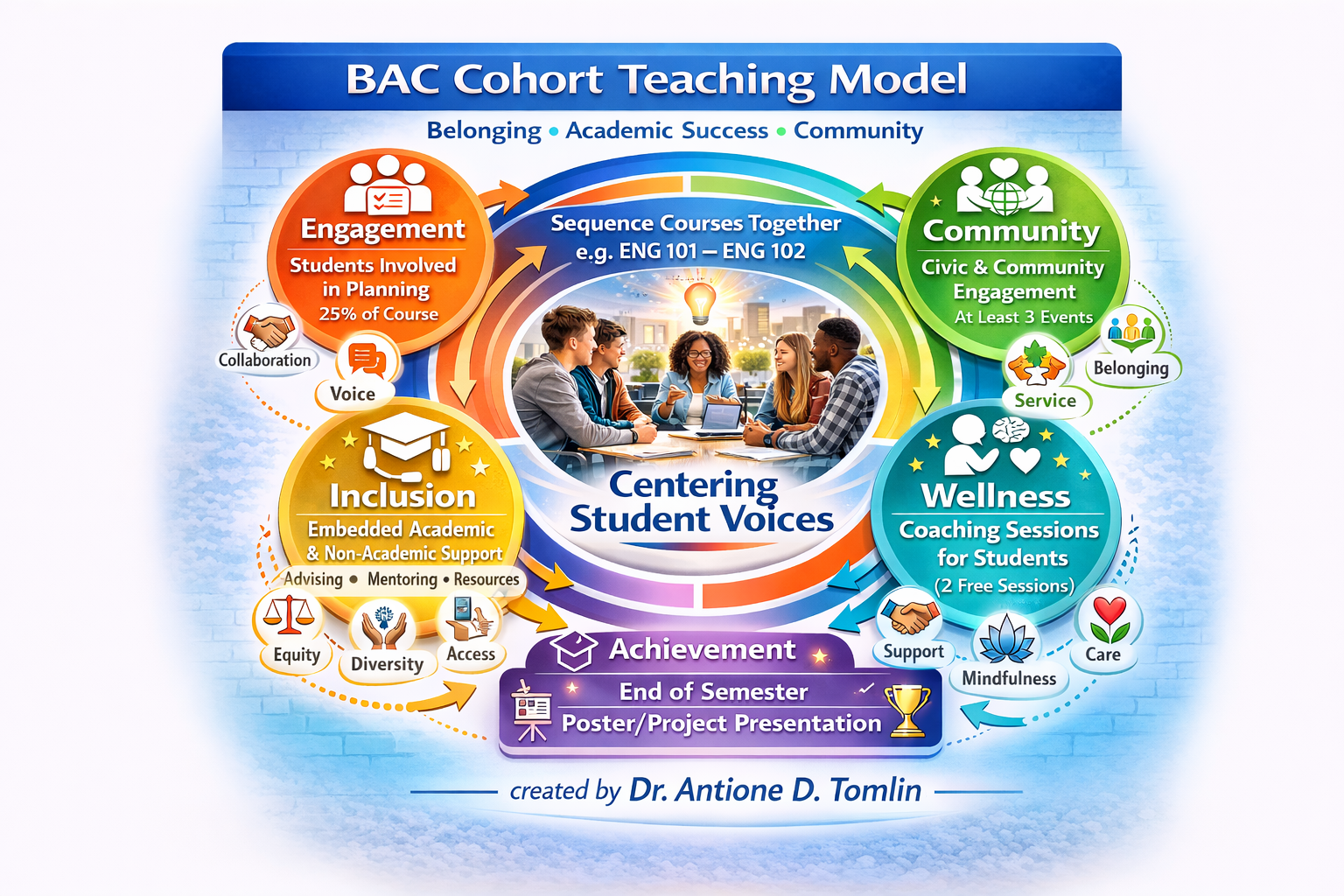
Core Components of the BAC Cohort Teaching Model
Sequence-Based Cohort Progression
One foundational element of the BAC model is the option for students to move through sequence courses or other courses together, such as ENG 101 followed by ENG 102, extending relational continuity beyond a single semester. While sequence cohorts are not a requirement of the model, the BAC approach was initially developed through back-to-back courses where students progressed together with the same instructor. This semester-to-semester continuity reinforces the model’s commitment to sustained engagement rather than isolated intervention. By maintaining cohort membership across sequential courses, the BAC model reduces social fragmentation, increases peer accountability, and deepens academic trust. Rather than students “starting over” each semester with new classmates and instructors, they continue building relationships that have already been established. This intentional design feature disrupts the cyclical loss of belonging that often accompanies course transitions and allows students to develop deeper academic and relational connections.
Student Co-Creation of Course Content
A defining component of the BAC model is the intentional redistribution of classroom authority by involving students in planning at least 25 percent of the course. Students may contribute to the development of course units, assignments, discussion topics, or lesson plans. This co-creation process centers the learning space around personalized instruction, self-expression, empowerment, and culturally affirming discussions that validate and amplify student experiences. It also shifts students from passive recipients of curriculum to intellectual contributors. By participating in the design of their learning experience, students develop stronger self-advocacy and leadership skills while also becoming more invested in the course itself. The process encourages deeper engagement and allows the course to reflect the interests, concerns, and perspectives of the students within the cohort.
Civic and Community Engagement
Another central element of the BAC Cohort Teaching Model is the integration of civic and community engagement experiences directly into the curriculum. Each cohort is expected to host at least three civic or community engagement events during the semester. These events are planned, facilitated, and hosted by students, and they are often open to faculty, staff, students, and members of the broader community. Examples of events may include community dialogues, panel discussions, campus workshops, or public presentations connected to course themes. This component positions students as knowledge producers and community conveners rather than solely classroom participants. Civic engagement operationalizes belonging not as sentiment but as participation and contribution to public conversation. By connecting academic inquiry with real-world issues, students are encouraged to think critically about their communities and the social issues that shape their lived and learned experiences.
Embedded Academic and Non-Academic Support
The BAC Cohort Teaching Model intentionally integrates targeted support services directly into the classroom experience. These supports may include academic advising, mentorship programs, retention specialists, or student success initiatives. Rather than expecting students to independently navigate institutional systems and find resources on their own, the BAC model embeds support within the learning environment itself. Campus collaborators may attend class sessions, build rapport with students, and serve as accessible resources throughout the semester. This approach lowers barriers to accessing support services and creates a more collaborative network around student success. It also reinforces the idea that academic success is supported through relationships and community rather than individual effort alone.
Coaching Sessions
A unique feature of the BAC model is the encouragement of two free coaching sessions for students each semester. These coaching sessions promote personal reflection, goal-setting, accountability, and identity development beyond course assignments. Coaching provides students with an opportunity to explore their goals, challenges, and personal growth in a structured environment that complements academic learning. These sessions help students build confidence, develop resilience, and strengthen their sense of purpose. Although coaching participation is not mandatory, it is strongly encouraged as a way to extend the relational and developmental framework of the classroom.
Culminating Poster or Project Presentation
The semester concludes with a public research or project presentation, often conducted as a gallery walk or showcase event. During this culminating experience, students present posters or projects that reflect both their academic research and their experience within the BAC cohort. Students visually represent their research findings, highlight key insights from their projects, and share reflections about what they have learned throughout the semester. These presentations are typically open to faculty, staff, and other students. This culminating event serves as both an academic assessment and a leadership opportunity. By presenting their work publicly, students step into the role of scholars and contributors to broader campus dialogue.
The BAC Model as an Ecosystem of Engagement
Taken together, these components create a cohesive instructional ecosystem rather than a series of isolated interventions. The BAC Cohort Teaching Model intentionally aligns culturally relevant pedagogy, universal design, embedded support systems, civic engagement, student co-creation, and public scholarship. Through this integrated approach, belonging becomes more than a conceptual goal—it becomes a structural design principle within the course. When belonging is intentionally designed into the learning environment, students are more likely to engage academically, participate actively in discussions, build meaningful relationships with peers and faculty, and develop confidence in their intellectual voices. Ultimately, the BAC Cohort Teaching Model suggests that belonging is not an add-on to academic success; it is a foundational condition that helps make academic success possible.
Interested in learning more about the background, inception, and pilot of the BAC Cohort Teaching Model? Review the Fall 2025 Recap Report and reach out to Dr. Tomlin if you have any questions!

Author’s Bio
Antione D. Tomlin, PhD, PCC, is a tenured Associate Professor and Chair of Academic Literacies at Anne Arundel Community College. Dr. Tomlin is also an ICF Certified Life Coach. Feel free to reach out at www.drantionetomlin.com or on X (Twitter) @Tomlinantione.

Build your Dossier with Interfolio.
Advance with confidence.
Applying for academic programs or positions requires many artifacts. Put your best foot forward with Interfolio. Start building your dossier for free today.